Showing posts with label Terrorism. Show all posts

Tuesday, December 29, 2009

End of 2009 Countdown

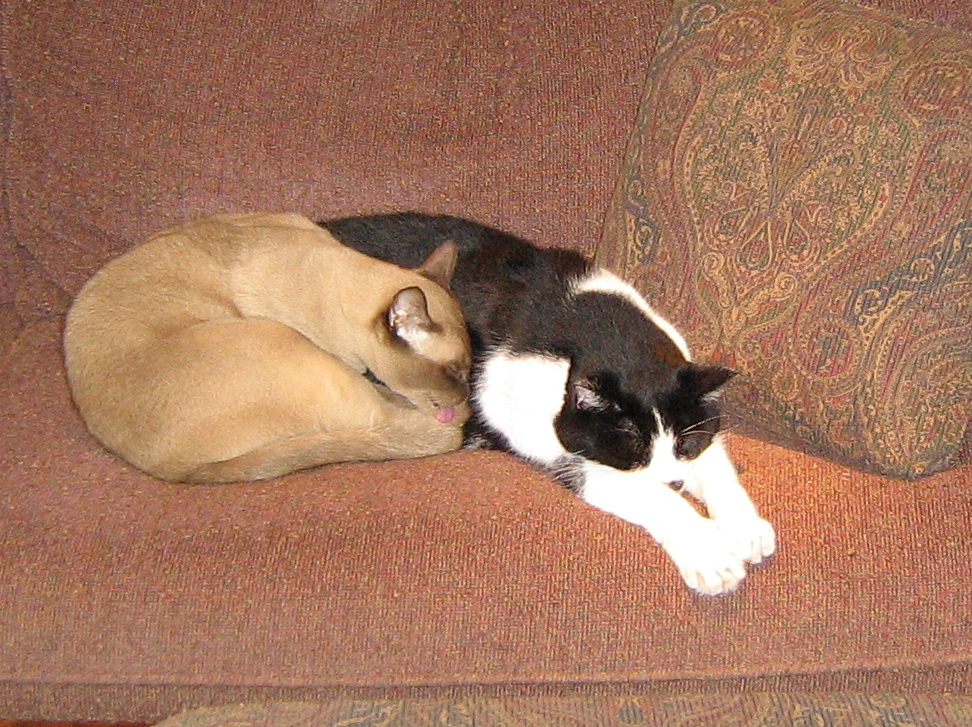
This is a good photo for a "Peace on Earth" Christmas card. The cats' official names are Rocco and Junior, but around the house we call them "Schmall Kitty" and "Young Man." Don't ask me why. It's just us.


This is a great time of year for many reasons. One thing I've been enjoying is the attack of rationality and perspective that has gripped much of the news being reported. It's like there's a sudden realization that the molehill-conflicts we have been angry and screaming about all year really aren't that important.

One of the best things I read all year was a series of in-depth profiles of former Islamic terrorists called "Renouncing Islamism: To the Brink and Back Again." This is the best glimpse I've ever had into "Why Would Someone Do This?" It's a very long story, but a very good picture of the real genesis of terrorism.

Wednesday, August 8, 2007

Giuliani is Not Who He Seems


Quote of the day:
“It will be generally found that those who sneer habitually at human nature are among its worst and least pleasant examples.”
--Charles Dickens

Statistic of the Day:
Estimated percentage of personal computers worldwide that have been hijacked and are currently sending spam without their owner’s knowledge: 11%
--Forbes, July 25, 2007 (Hint: disconnect from the web, clear your cache, run anti-virus software)

Quote of the day no. 2:
“Nearly every major accomplishment [Rudy] Giuliani points to today either had already been achieved or was well on the way to being achieved by the time he became mayor.”
--Kevin Baker in the August “Harper’s”

Rudy Giuliani currently is the leading candidate for the Republican presidential nomination. Our well-imprinted view of him is based on three things.

First, he was extraordinarily eloquent as a government spokesman just after the destruction of the World Trade Center. In those days, we so desperately needed someone to put our sorrow, fear and anger into words--and he did that with great skill.

Second, in the years since 9/11, he has popped up in the media from time to time with comments about being “tough on terrorism.”

Third, there is a vague line that has been repeated often by commentators during the campaign that, when he was mayor, he “turned New York City around.” The facts don’t support this.

For example, it was Mayor David Dinkins who signed into law a tax surcharge that enabled the hiring of six thousand additional police officers. As a result, during Dinkins’ term the murder and robbery rates fell by 14%, burglary fell by 18% and auto theft fell by 24%. According to Kevin Baker, “the city’s crime rate dropped in all seven FBI major-felony categories for the first time in nearly 40 years.”

This is how things were heading when Giuliani took over as mayor. Yet he claims, and we still believe, that he alone is responsible for “cleaning up” New York City.

When 9/11 happened, Giuliani’s Office of Emergency Management completely failed to coordinate rescue efforts between the police and fire departments. There was not even an effective system for the fire department to communicate with itself.

That deficiency had been known since the 1993 World Trade Center attack, and led to hundreds of firefighters being cut off in the towers. There was no way to tell them the buildings were in danger of collapse.

Giuliani was on-site during the disaster and knew of the communications problem, but made no attempt to keep the firefighters informed. Later, he told the 9/11 Commission that the firefighters had refused orders to evacuate, according to “New York Times” reporters Jim Dwyer and Kevin Flynn.

Among the many people he worked with as mayor, Giuliani has a reputation as a bully--arrogant, egotistical, authoritarian, and very prickly in the face of criticism. In his mayoral campaigns, he had no qualms about distorting the records of, and even destroying the reputations of, those he disagreed with.

Baker also says this:
“The worst excesses of the Bush regime have stemmed directly from its leader’s character--that is, its rampant cronyism; its arrogance and egotism; its peremptory, bullying tone and methods; its refusal to brook criticism from within or without; its frightening authoritarian impulses; its need to create enemies as a means of governing; its impulsiveness and naivete; its outright contempt for the law; and its truly staggering ability to substitute its own versions of what it wishes the world to be for any recognition of objective reality.

“Judging from his record in gaining and holding power, there is no reason to believe that Rudolph Giuliani’s presidency would be substantially different.”

Saturday, April 7, 2007

War Is No Longer a Last Resort


Quote of the day:
“Man is the only animal that laughs and has a state legislature.”
--Samuel Butler

Quote of the day no. 2:
“We should view violent Islamic radicals as an international criminal conspiracy. We should make common cause with other nations in destroying this conspiracy, using methods similar to those used against the mafia.”
--Andrew J. Bacevich

As important as it is that we step back from the mess in Iraq in order to gain some rational and historical perspective, we don’t seem to do it. It may be that the situation gets us so worked up that we can’t manage anything but anger, posturing and endlessly repeated catch phrases from all sides.

In his book The New American Militarism: How Americans are Seduced by War, Andrew Bacevich takes this step back. He looks at the development of our attitudes about American power and influence over the last hundred years, and his observations are worth a look.

He says this: “In former times American policymakers treated (or at least pretended to treat) the use of force as evidence that diplomacy had failed. In our own time they have concluded (in the words of Vice President Dick Cheney) that force ‘makes your diplomacy more effective going forward, dealing with other problems.’ Policymakers have come to see coercion as a sort of all-purpose tool.”

In an interview in the March 2007 Sun, Bacevich gives this explanation for why he thinks we cannot win in Iraq: “The leaders of the Arab world took several decades to realize they were not suited for Western-style war, with tanks, bombers, heavy artillery and so on.

“We now have a generation of Arab leaders--and perhaps Muslim leaders in general--who are choosing military techniques that play to the strengths of their people and their societies. They don’t need fighter-bombers; they don’t want tanks. As the resistance in Iraq continues to demonstrate on a daily basis, they have developed a strategy that we don’t know how to defeat. And any statesman with half a brain should know that if you can’t defeat your enemies militarily, then you need to rethink the war option.”

Why do we do this? It’s because “Politicians on both sides are wedded to what I call the ‘narrative of the American century.’ It goes like this: Beginning with the Japanese attack on Pearl Harbor on December 7, 1941, the U.S. finally broke away from its isolationist roots and recognized its responsibility as a world leader.

“From that day forward, according to the narrative, the U.S. has been engaged in a great campaign to spread freedom around the world. We did it to great effect in World War II. We did it again, albeit over a longer period and with some missteps, in the Cold War.

Bacevich says the narrative has continued: “Since September 11, 2001, we have recommitted ourselves to this campaign. Just as we brought freedom to Europe and East Asia and the old Soviet bloc, we are now engaged in an effort to bring freedom to the Muslim world.” That’s what our self-narrative says.

He goes on: “And so we have this catastrophic war in Iraq, which the president sees as the first step toward spreading freedom in the Muslim world. And the Democrats in Washington have trouble articulating a critique of the war because they are bound to the same narrative.

“Both Left and Right are attached to a concept of history that in some way served our purposes back in the forties and fifties, but today has become irrelevant and counterproductive.”

Wednesday, January 31, 2007

How Terrorists are Made


Quote of the day:
"Life is always a tightrope or a feather bed. Give me the tightrope."
--Edith Wharton

Statistic of the day:
Number of foreign visitors to New York City in 2006:
44 million.

Since September 11th, there has been lots of public discussion about Al Qaeda-based terrorism, and some about its origins. But we have heard very little empirical research or even objective observation related to how actual human beings wind up as terrorists.

Former CIA case officer and forensic psychologist Marc Sageman closely studied the life histories of 172 known militants, and reported his conclusions to the September 11th Commission. His “profile” of those who became terrorists is interesting in its resemblance to those who got very involved with religious cults in the 1970s and 80s.

Here is a brief excerpt from a piece by Raffi Khatchadourian in the January 22nd New Yorker:

“Sageman discovered that most Al Qaeda operatives had been radicalized in the West and were from caring, intact families that had solidly middle- or upper-class economic backgrounds. Their families were religious but generally mainstream. The vast majority of the men did not have criminal records or any history of mental disorders. Moreover, there was little evidence of coordinated recruitment, coercion or brainwashing. Al Qaeda’s leaders waited for aspiring jihadists to come to them--and then accepted only a small percentage. Joining the jihad, Sageman realized, was like trying to get into a highly selective college: many apply, but only a few are accepted.

“Perhaps his most unexpected conclusion was that ideology and political grievances played a minimal role during the initial stages of enlistment. ‘The only significant finding was that the future terrorists felt isolated, lonely, and emotionally alienated,’ Sageman told the September 11th Commission in 2003.”

Friday, January 5, 2007

Not Islam v. the West, But Islam vs.Islam


Quote of the day:
“I know collectors with 40,000 bottles who if you poured them a glass of Gallo Hearty Burgundy wouldn’t know the difference.”
--Robert M. Parker, Jr.

Many assumptions and stereotypes continue to come to us about Muslims, Arabs, and what 9/11 was about. Some of them need closer examination.

Reza Aslan graduated from the Harvard Divinity School, where he did a scholarly study of the Koran. His book "No god but God: The Origins, Evolution and Future of Islam" helped to dispel some of our questionably broad assumptions, but they are persistent. He was interviewed in the December "Sun," and made some very interesting observations:

“We have this idea in the U.S. that we’re the primary target of the jihadists, but we’re not. They call us the ‘far enemy.’ The primary target is the older Islamic institutions.”

“By bin Laden’s own admission, al-Qaeda will never reestablish the caliphate. A few years ago the majority of Muslims didn’t even know what the caliphate was, let alone want it to come back. But when the president of the United States of America, the most powerful man on earth, announced that he was afraid bin Laden could re-create the caliphate, it gave an air of legitimacy to this absurd idea.... For Bush, talking about the caliphate may have been a good strategy for getting reelected, but it is a terrible strategy for winning this ‘war on terror’ that we’re supposed to be fighting.”

“Five years later [after 9/11], and we’re still asking ‘Why did they attack us?’ That question has been answered a hundred times over by the jihadists. In their own words they have said the purpose of the attacks of September 11 was to goad the United States into an exaggerated retaliation against the Muslim world. Then they could frame the U.S. military response as a ‘war against Islam.’

“The irony is that it didn’t work at first. The war in Afghanistan had almost unanimous support in the Arab and Muslim worlds, even from some of the U.S.’s staunchest enemies.

“In one Muslim country, immediately after September 11, hundreds of thousands of people poured into the streets, lot candles, and prayed in an exuberant display of compassion for the U.S. That country was Iran.”

Wednesday, November 22, 2006

Iraq Logic


Seasonal reminder of the day:
The USDA recommends not stuffing the turkey, but baking the stuffing separately.

Quote of the day:
“Yeah, maybe. Whatever. Again, I don’t really care.”
--Darby Conley, in today’s Get Fuzzy

Richard A. Clarke is a former counter-terrorism expert in the Clinton and Bush administrations. His excellent book about Al Qaeda and September 11th, Against All Enemies, is a compelling summary of the U.S. government’s knowledge of, and response to, Osama bin Laden and al Qaeda in the years leading up to September 11, 2001.

One important point he made, in detail, was that the Bush administration was aware of the immediate risks that al Qaeda posed, yet chose to focus its attention on other matters. Clarke’s thesis in that book has yet to be refuted in any major way. On Monday, he wrote this about Iraq:

“Too often in the Iraq debate, we have let intuitions, slogans and appealing thoughts cloud logic. Perhaps the most troublesome example is the argument that we must honor the American dead by staying until we can build something worthy of their sacrifice.

“Stripped of its emotional tones, this argument is, in economic analysis, an appeal to sunk cost. An MIT professor once threatened to fail me if I ever justified actions based on sunk cost--so I learned what is gone is gone, and what is left we should conserve, cherish and employ wisely.

“A similarly illogical argument for staying in Iraq is that chaos would follow any near-term U.S. withdrawal. The flaw lies not in the concept that chaos will happen, but rather in thinking that chaos would only happen if we withdraw in the near term. Chaos will almost certainly follow any U.S. withdrawal, whether in 2008 or 2012.”

Thursday, September 14, 2006

Remembering Five Years Ago


“If a man will begin with certainties, he shall end in doubts; but if he will be content to begin with doubts he shall end in certainties.”
--Sir Francis Bacon

It was about this time in 2001 when we started to see flags everywhere. You could buy one in the checkout lane of the grocery store. It was the oh-so-brief post-9/11 time when displaying the flag carried no political agenda beyond saying “I am an American.”

As Hendrik Hertzberg reminds us in the September 11th "New Yorker," this week five years ago the French newspaper "Le Monde" had a front-page headline “Nouse Sommes Tous Americains”--”we are all Americans.” He says, “Messages of solidarity and indignation came from Libya and Syria as well as from Germany and Israel; flowers and funeral wreaths piled up in front of American Embassies from London to Beijing; in Iran, a candlelight vigil expressed sympathy.”

Hertzberg points out that “no one realistically expected that the mood of fellow-feeling and cooperation would long persist.... What few expected was how comprehensively that initial spirit would be ruined by the policies and behavior of our government.”

He is talking about primarily America’s reputation elsewhere in the world. But I think our self-image and self-respect has taken a beating, too. Where have all the flags gone?

I did see a car with a flag just this afternoon. It was a flag for the San Diego Chargers.

Friday, September 8, 2006

Are We Growing Up?

CNN’s William Schneider is today reporting on results of a poll which asks if America “will ever be the same again” after September 11th. In the days following the attack, 54% said no. Over the last few weeks, 70% said no.

Reality is sinking in. You could say this poll measures an increase in fear or insecurity, and behind it lies a desire to restore the pre-9/11 world. But I think it indicates the reverse--that is, we are beginning to really accept the world as it is, not as we convinced ourselves it was.

I believe it’s a hopeful sign. Maybe it means we are growing up--that is, that we increasingly realize we are part of the world, and that we cannot ignore what goes on elsewhere. Maybe it also means we are beginning to understand and even accept our ongoing, long-term responsibilities as the most powerful and prosperous nation on earth.

Saturday, September 2, 2006

Do We Know What is Plausible?

A report by Jim Dwyer in the "New York Times" this morning says this:

"A nationwide poll taken earlier this summer by the Scripps Survey Research Center at Ohio University found that more than a third of those surveyed said the federal government either took part in the [September 11th] attacks or allowed them to happen. Sixteen percent said the destruction of the trade towers were aided by explosives hidden in the buildings."

I understand that after any major event there will be a certain amount (maybe 5%) of fanatical and permanent skepticism about how it happened (such as the Kennedy assassination) or indeed whether it happened (such as the July 1969 moon landing). But the fact that one-third of Americans seem to be this skeptical about 9/11 is deeply disturbing.

I don't know if there is a growth in generalized paranoia and suspicion. Perhaps. But it is very clear that no amount of evidence seems to shake this "permanent" skepticism. Each bit of data is dismissed by simply being questioned. It's as if the only thing that is trusted is our own paranoia. One out of three of us refuse to be "unconvinced" no matter what new facts are presented to us, and we feel no responsibility for offering data or facts to back up whatever our version of the story is. The important thing to us is simply that the most plausible, most reasonable and most carefully investigated version of the story is wrong.

We seem to be living in a sort of courtroom culture in which one-third of us are defense attorneys whose only job is to refute the evidence. Don't get me wrong--all evidence deserves to be questioned and examined. Most often, though, it seems that the mere act of questioning evidence has become reason enough to cast it aside. Are we not trusting our own eyes, ears and judgment anymore? If not, what or who do we trust?